
Club News
All the latest news for PETERBOROUGH BIRD CLUB
PBC Lakenheath Fen Trip – 07/06/25
Jun 9, 2025 Web Support
We set of from the reserve office following the path towards New Fen. Blackcap was the first bird heard followed by a great display of flying and singing from a very showy Whitethroat. At New Fen we waited hopefully for a Bittern whilst watching Mallard and Coot ducklings. Reed Warblers, Sedge Warbler and Reed Bunting flew across in front of us. We were fortunate to see a Hobby and a Cuckoo in flight heading in opposite directions. Eventually we achieved our objective and saw three Bittern flights. A first ever Bittern for some of those present.
We then followed the newly cut track alongside the reedbed giving good views across the top of the reedbed. Another Bitter flew across the reedbed towards us and went into the reeds close to us. We then followed a family of Greylags and their gosling up to the end of the track. From there we walked the short distance to the Mere. Bitterns have not bred there this year and no sign of the usual Kingfisher but we had excellent views of a pair of adult Great Crested Grebes catching fish and feeding it to their humbugs (duckling). 2 Hobbies also became very active and flew low over the reeds in front of the trees giving excellent views including catching and eating dragonflies whilst on the wing, After this we moved to Joist Fen and lunch in the rain! Whilst at Joist Fen we had another 4 Bittern flights, good scope views of a very persistent Cuckoo, 2 Great White Egrets and Cranes were heard calling but could not be seen. We left Joist Fen to walk back to the reserve office via the path alongside the River Little Ouse. Heron was the only bird seen until we arrived at the Hockwold Washes. Here there was a mix of ducks and waders including Mallard, Shovelor, Gadwall, Coot, Moorhen, 2 Avocets, several Redshanks and Black-tailed Godwits. Then back to the office for one of the best spots of the day - a freezer full of Ronaldos ice-cream. An excellent finish to a very good day.
Details of Future Trips to Essex/Suffolk 2025 and Wiltshire/Hampshire 2026
Jun 9, 2025 Web Support
Please let Richard know (rfw1967@hotmail.co.uk) if you want to join the trip or contact him if you have any questions.
Wales 2025 – Trip Report
May 20, 2025 Web Support
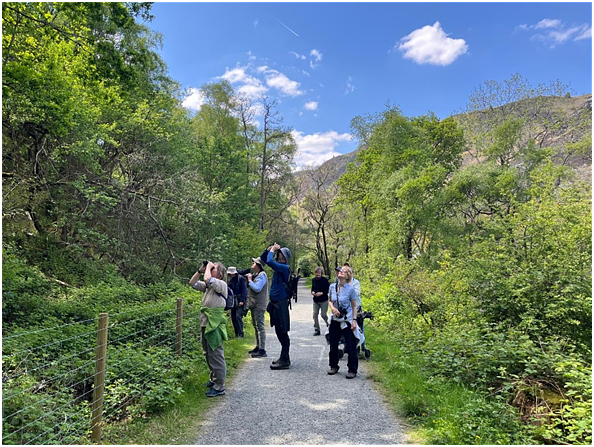
We started by exploring the ancient oak woodland around Afon Elan just below the dam. Hearing birds was easy, but finding them amongst trees in leaf was more tricky, but eventually we managed to locate Pied Flycatcher, Spotted Flycatcher, Redstart and Wood Warbler.
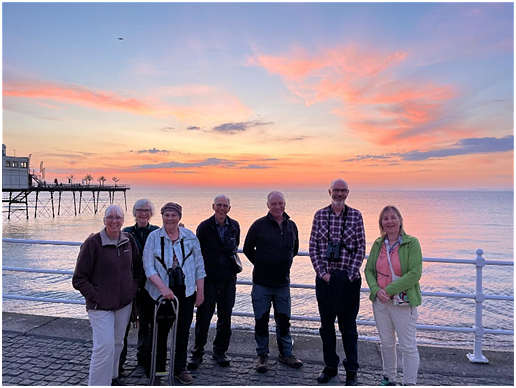
A few people took the scenic route to Aberystwyth (where we were staying for the first night) and were rewarded with Wheatear and Ring Ouzel.
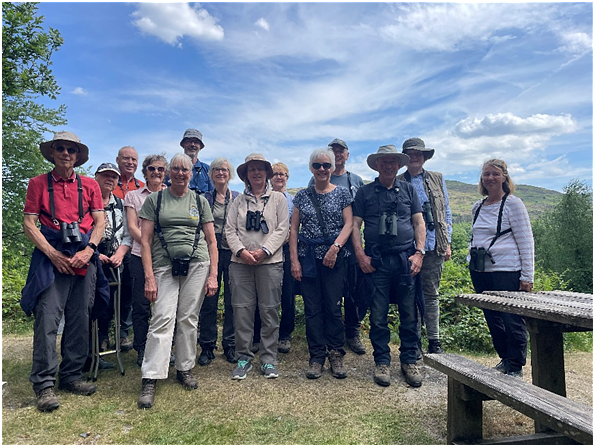
On day 2 we visited Ynys-hir and Snowdonia. Ynys-hir is a delightful reserve including deciduous woodland and fantastic views across the Afon Dyfi estuary.
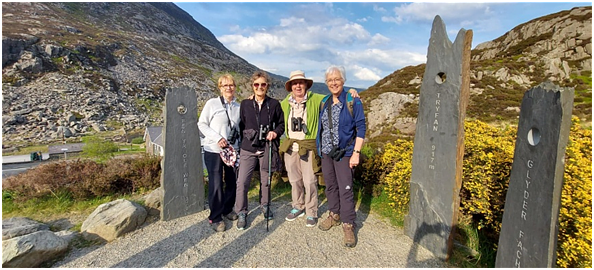
En route to Bangor we stopped at Llyn Ogwen where we walked a little way up Glyder Fawr (we got to 400m above sea level whereas the summit is at 1001m). Surprising we saw a Great Crested Grebe and a pair of Canada Geese as well as Meadow Pipit, Stonechat, Cuckoo, and Raven.
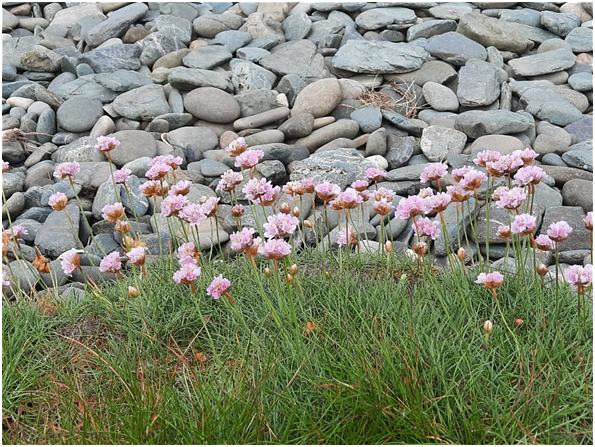
The third day was spent on Anglesey. Cemlyn Bay, a wild and wonderful place on the northern coast of the island, is home to a large tern colony which affords very close views of Arctic, Common and Sandwich Terns. We also saw Gannet, Red-breasted Merganser and Whimbrel.
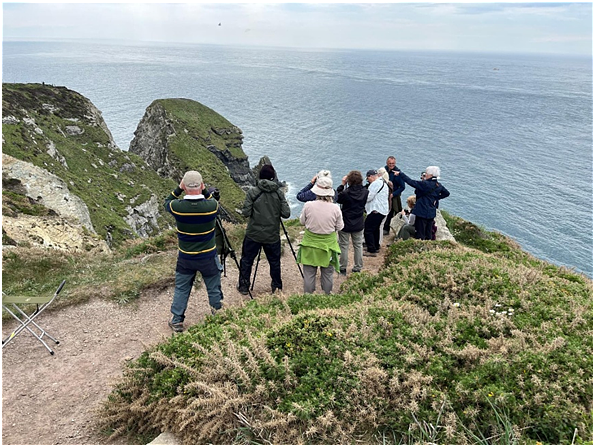
Anglesey is actually quite flat, but that can’t be said of Holy Island the home of South Stack RSPB. Here we had great views of Chough and various auks including Puffin. We also saw Shag, Fulmar and Kittiwake, but only in small numbers unfortunately.
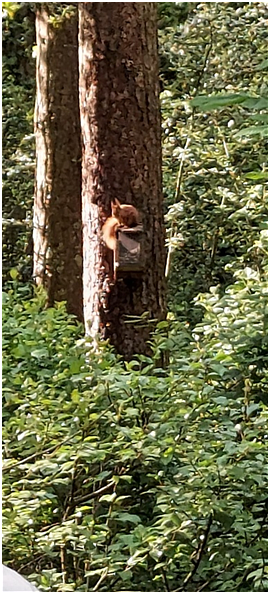
We briefly stopped at Holyhead Harbour to catch up with a few Black Guillemot before heading to Newborough Forest in search of Red Squirrel. We quickly worked out that the best approach to squirrel watching is to find a feeder and wait. Before long 5 appeared shortly before the sky turned black and the heavens opened. However, apart from an hour of heavy rain, we were blessed with exceptional weather – 20 degrees C, blue sky and light breeze.
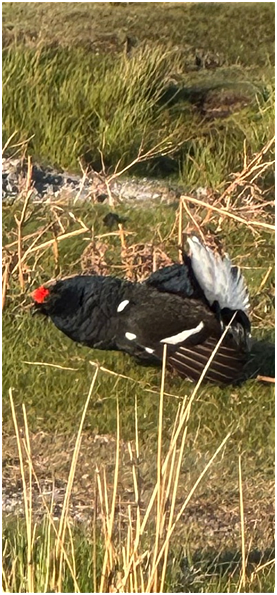
On the final day we visited World’s End, an area of moorland near Wrexham. A few people made an early start and caught the end of a Black Grouse lek. However, everybody managed to see Red Grouse, Whinchat and Wheatear.
Overall we saw 101 species across deciduous and pine forest, moorland, mountain, rivers, streams and lakes, cliffs, shingle beaches, reed beds and estuaries.
Outdoor Events Programme with Titchwell rescheduled
Feb 26, 2025 Web Support
A second visit to the Brecks. This time to the fabulous RSPB Lakenheath Fen reserve. The reserve is newly extended with additional land added along the river. At this time of year we have an excellent chance of multiple Bittern sightings, nesting Marsh Harriers, Hobby hawking dragonflies and Cuckoos. There is also a chance of seeing the breeding Crane population. Please carry a packed lunch and drink with you as the plan is to take lunch at Joist Fen to give the maximum time searching for target species from this fabulous viewpoint. After lunch we will walk back along the river bank to the visitors centre. From here we will take a 10 minute drive to NWT Weeting Heath. This is a specialist reserve targeted at breeding the rare and endangered Stone Curlew. For RSPB Lakenheath park at the visitors centre IP27 9AD. For NWT park at the visitors centre IP27 0FD. Both reserves have entry charges for non-members. Leader Stewart Short & Ian Gordon
An afternoons birding at RSPB Titchwell followed by a Fish and Chip supper at Erics and then transfer to NNR Dersingham Bog where we will arrive by 8PM for anybody wanting to just join for the evening. The main aim of this visit is to hear, and hopefully see, the unique Nightjars churring and flying around sunset time. This is the nearest site to Peterborough for you to enjoy this unique spectacle. In addition to Nightjars, we hope to see Woodlark, Woodcock making their roding flights, Stonechat and Tree Pipits. Meet at RSPB Titchwell car park PE31 8BB at 1500. Meet at Dersingham Bog PE31 6HA at 2000hrs. Leader Stewart Short/Ian Gordon
20-21/09/25 Essex/Suffolk 2025
PBC Trip to RSPB Frampton Marsh - 16th February
Feb 19, 2025 Web Support
Membership Reminder
Feb 14, 2025 Web Support
Happy New Year.
This will enable the club to continue
- to provide quality indoor events
- worthwhile outdoor events
- bring like minded people together to pursue nature, particularly birds
Deeping Lakes Outdoor Meeting 5/2/2025 Report
Feb 5, 2025 Web Support
Eyebrook Reservoir Outdoor Meeting 15/1/2025 Report
Jan 21, 2025 Web Support
affected by the conditions? The outlook on the way to the reservoir was not promising, heavy mis
over the hills as I entered Rutland. However, upon arrival the reservoir was clear! 14 members, a
good turnout, ventured to the location to be greeted with good views several Pintails, Golden Eye
and 3 male Smew with a red headed female diving and being pursued by the males on
resurfacing.
We headed along the shore towards the bridge over the Eye Brook. On the way, a snipe was
spotted by Mr. Eagleye, Stewart, as it flew over the reservoir. We could see a group of Lapwing
on the muddy area at the bridge end of the water which also contained a group of Golden Plover
and several Dunlin feeding. A group of Greylag Geese were feeding in the ploughed field on th
opposite hillside that also contained two Egyptian Geese and on the edge of the field were tw
Stock Doves feeding around a pheasant feeder.
At the bridge is a well stocked feeding station which attracted different tit species, including
Marsh Tits giving good views as they fed.
We headed back to to car parking area for lunch after which several members departed leaving a
small group to head off to the other side of the reservoir. Before departure, Coal Tits were spotte
in ivy growing up a tree with a Rook behind. Upon arrival at the farm gate which allows views over
the dam end of the reservoir, the Sun very kindly appeared and some of the mist was dissipated
and a Raven was spotted flying between the mist clouds. From here we returned to the ca
parking area which marked the end of an enjoyable time birding at Eyebrook Reservoir resulting in
a count of 50 species of birds being identified during our visit.
Welney Trip Report
Nov 29, 2024 Web Support
Stewart
Eldernell Outdoor Meeting
Nov 23, 2024 Web Support